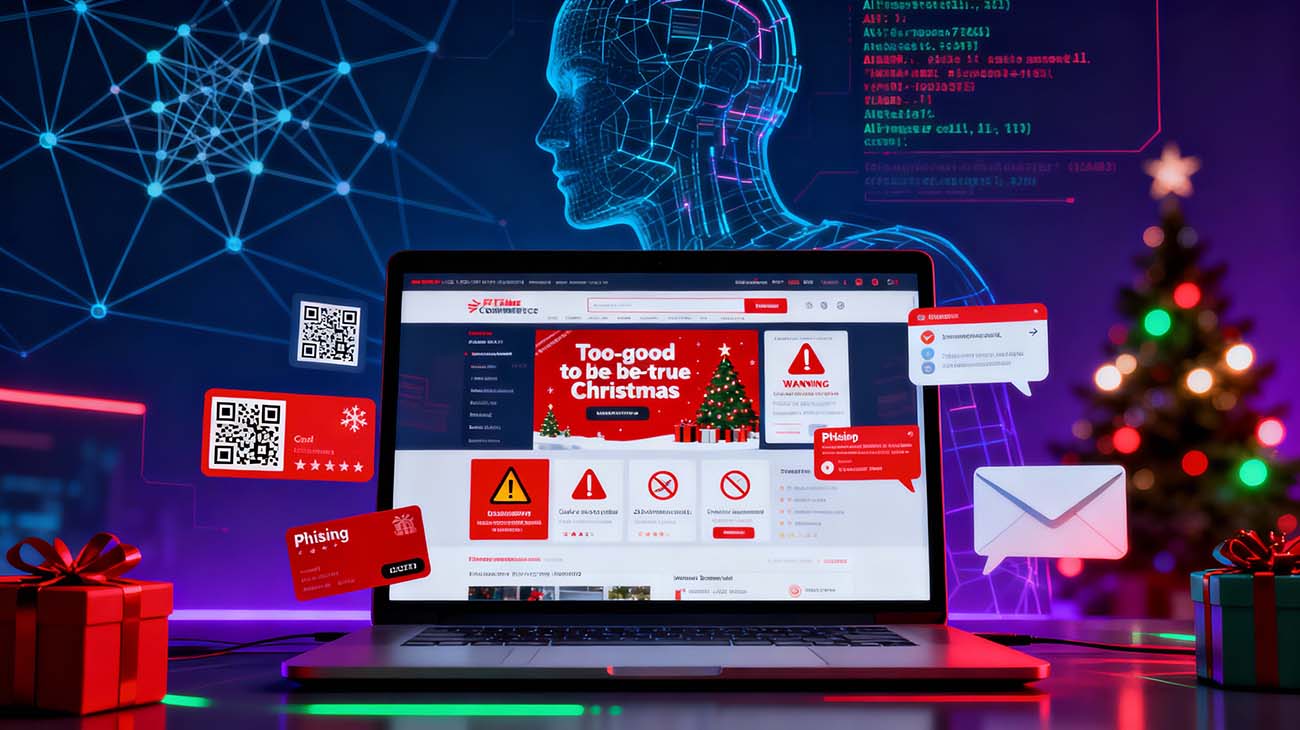
Phish‑mas 2025: How AI Is Supercharging Holiday Scams
Introduction
Holiday shopping has always attracted scammers, but 2025 is different: AI now sits in the middle of the fraud economy, quietly boosting scale, realism, and conversion rates for holiday scams. From Black Friday “flash sales” to fake shipping alerts and bank fraud calls, attackers are using generative models, deepfakes, and automation to industrialize seasonal crime.
This post breaks down how AI‑enabled holiday scams work, why account takeover fraud is exploding, and practical defenses for consumers, banks, and security teams heading into the busiest shopping weeks of the year.
The 2025 Holiday Threat Picture
Record seasonal fraud and account takeover
Law enforcement and financial regulators are flagging 2025 as a breakout year for sophisticated account takeover (ATO) campaigns tied to holiday shopping. The FBI has received more than 5,100 ATO complaints this year with losses exceeding 262 million dollars, driven largely by scams impersonating banks and payment providers.
These attacks do not rely on exotic zero‑days; they ride on social engineering at scale. Victims are funneled through phishing links, search ads, or unsolicited calls until they hand over credentials, multi‑factor codes, or card details that allow criminals to reset passwords and drain funds.
Why holidays are the perfect storm
The holiday period concentrates three attacker advantages: volume, urgency, and noise.
- Volume: Massive spikes in online purchases, shipping notifications, and promo emails make it easy to hide malicious messages in the noise.
- Urgency: Limited‑time deals, shipping cutoffs, and travel windows pressure people into reacting quickly instead of validating links and senders.
- Noise: Consumers expect email, SMS, and app alerts from retailers and banks, lowering suspicion when “security” messages arrive out of the blue.
AI models trained on public content and stolen data make it trivial for attackers to blend into that background, matching brand tone, templates, and timing.
AI‑Upgraded Holiday Scam Playbooks
Polished phishing at industrial scale
The classic holiday phish is now AI‑assisted at every step.
- Generative models write brand‑consistent emails and SMS messages with correct grammar, localized language, and personalized details, removing many of the usual red flags.
- Attackers feed models with past breach data, open‑source intelligence, and social media details to tailor scams to specific merchants, banks, and even prior transactions.
- AI‑driven infrastructure continuously A/B tests subject lines, body content, and call‑to‑action phrasing to maximize click‑through and credential capture rates.
Vendors tracking the 2025 season report triple‑digit growth in holiday‑themed phishing and a surge in campaigns mimicking major brands, shipping providers, and digital wallet platforms.
Fake e‑commerce sites and dark ad campaigns
Holiday shoppers are also being steered toward bogus storefronts powered by AI on both the front‑end and back‑end.
- AI tools generate full product catalogs, marketing copy, and images for non‑existent items or counterfeit goods within hours.
- Fraudsters run search and social ad campaigns that look indistinguishable from legitimate promotions, bidding on brand keywords like “Black Friday,” “Christmas sale,” and major retailer names.
- Payment pages harvest card data and personal information, then either never ship the goods or use low‑value shipments as cover while reselling stolen data and fueling additional scams.
Threat intelligence sources have observed at least hundreds of malicious, holiday‑themed domains spun up in recent months, many explicitly spoofing large marketplaces and popular retail platforms.
QR codes, mobile “mishing,” and fake apps
Mobile‑centric scams are also evolving with AI support.
- QR‑code campaigns promise shipping updates, loyalty rewards, or prize draws, but redirect to credential harvesters or malware downloads hosted on lookalike domains.
- SMS “mishing” uses AI‑generated copy to impersonate carriers, banks, or government agencies with highly convincing language and localized context.
- Some campaigns push users toward trojanized mobile apps that intercept one‑time passcodes or session tokens, enabling follow‑on account takeover.
Vendors tracking mobile threats report a multiple‑fold increase in mobile phishing sites and in campaigns abusing trusted brand names to create urgency around supposed deliveries, refunds, or gift card balances.
Deepfake voices and “fraud desk” calls
AI voice cloning is turning ordinary fraud calls into high‑impact social engineering channels.
Attackers spoof the caller ID of banks or retailers and use cloned voices to pose as fraud investigators, insisting that “immediate action” is required to stop suspicious transactions. Call scripts are generated or refined by LLMs to handle objections, walk victims through “verification” steps, and ultimately extract credentials or push payments to mule accounts.
These techniques are particularly dangerous when combined with real transaction data from previous breaches, making the call feel like a continuation of a genuine interaction.
Inside AI‑Driven Account Takeover (ATO)
How criminals hijack bank and payment accounts
The FBI’s 2025 alert describes a familiar but increasingly automated pattern for ATO targeting bank, credit union, and payroll accounts.
- Initial contact: The victim receives an email, SMS, or call claiming suspicious activity, often referencing realistic amounts or merchants.
- Credential capture: They are directed to a spoofed site or “verified” phone workflow where they enter usernames, passwords, and multi‑factor codes.
- Takeover: Attackers log into the real institution, reset passwords, and change contact details, effectively locking out the legitimate user.
- Cash‑out: Funds are quickly wired to mule accounts, then pushed into cryptocurrency or other obfuscating channels to make recovery difficult.
Many of these campaigns leverage SEO poisoning and malicious ads so that victims searching for bank or retailer support numbers end up on fraudulent sites or phone trees first.
Why AI makes ATO more dangerous
AI strengthens each stage of the ATO pipeline.
- Discovery: Models analyze breached data and public footprints to prioritize high‑value targets and guess likely banks, merchants, or payroll providers.
- Social engineering: Language models and voice cloning craft messages and calls that match institutional tone, regional accents, and typical support flows.
- Operations: Fraud “playbooks” are embedded in automated workflows that pivot quickly between phishing, SMS, and phone calls based on victim behavior.
Security leaders note that the majority of ATO cases still originate with compromised credentials and weaknesses in human‑in‑the‑loop verification, not failures of core banking technology.
Practical Defenses for Consumers
Everyday habits that resist AI‑polished scams
Consumers do not need advanced tools to materially reduce risk; disciplined habits go a long way, especially during peak shopping months.
- Treat unsolicited urgency as hostile: If a bank, retailer, or shipper contacts you about fraud or deliveries, do not use the links or phone numbers in the message; instead, go through the official app, bookmarked website, or the number on the back of your card.
- Check domains, not just design: Logos, fonts, and product photos can all be AI‑generated, but domains and URLs are harder to fake; watch for subtle misspellings, extra words, or unusual top‑level domains, especially when arriving via ads.
- Harden authentication: Use a password manager, unique passwords, and phishing‑resistant MFA where available; review recovery questions and avoid answers that can be guessed from social media.
- Monitor accounts aggressively: Turn on transaction alerts for bank and card accounts, and review statements frequently during the holidays to catch small “test” charges and larger fraud quickly.
Red flags for holiday shopping and travel
Certain patterns should trigger extra scrutiny when dealing with online deals or rentals.
- Extreme discounts from unknown sellers, especially with countdown timers or “only X left” prompts designed to shut down rational checks.
- Requests to pay via irreversible methods such as gift cards, wire transfers, or peer‑to‑peer apps for first‑time merchants or rentals.
- New merchants with no verifiable history, limited contact details, or reviews that look copy‑pasted or suspiciously generic across platforms.
A quick search for the merchant name plus “reviews” or “scam” and a check of independent review platforms can often surface existing complaints.
Guidance for Security Teams and Financial Institutions
Strengthening controls against AI‑enabled holiday fraud
Defenders can adapt many of the same AI capabilities to detect and contain seasonal fraud spikes.
- Augment email and web defenses: Combine modern secure email gateways with behavioral analytics to detect unusual sending patterns, impersonation of executives or brands, and QR‑linked destinations that deviate from norms.
- Monitor for ATO signals: Instrument authentication and transaction flows to flag impossible travel, device changes, and deviations in transfer patterns, especially around new payees and high‑risk corridors.
- Tighten manual verification: For high‑value transfers or changes to contact details, require out‑of‑band verification via known channels, and train staff to expect AI‑generated documents and voices.
Educating customers and employees for “Phish‑mas”
Targeted awareness efforts can dramatically blunt the impact of AI‑polished scams.
- Run seasonal phishing drills and training modules that showcase real holiday scam patterns, including QR code abuse, mobile “mishing,” and deepfake voice scenarios.
- Provide simple, shareable checklists for customers covering verification steps, account hygiene, and how to report suspected fraud quickly.
- Coordinate with industry groups and law enforcement to share indicators of compromise, malicious domains, and observed campaign tactics in near real time.
2025’s “Phish‑mas” season demonstrates that AI is no longer a novelty in fraud—it is foundational infrastructure for how holiday scams are designed, deployed, and optimized. Security teams and everyday shoppers who adjust their assumptions and workflows now will be far better positioned for the even more automated seasons ahead.
References and Further Reading
- FBI IC3 — (Account Takeover Fraud via Impersonation of Financial Institutions)https://www.ic3.gov/PSA/2025/PSA251125
- ABA Banking Journal — (FBI Issues Alert About Account Takeover Fraud)https://bankingjournal.aba.com/2025/12/fbi-issues-alert-about-account-takeover-fraud/
- Fortinet — (Cyberthreats Targeting the 2025 Holiday Season: What CISOs Need to Know)https://www.fortinet.com/blog/threat-research/cyberthreats-targeting-2025-holiday-season-what-cisos-need-to-know
- Fortinet — (Threat Report Overview for 2025 Holiday Season)https://www.fortinet.com/content/dam/fortinet/assets/threat-reports/threat-report-overview-2025-holiday-season.pdf
- Darktrace — (Phishing Attempts Targeting Black Friday Shoppers Surge)https://www.darktrace.com/news/phishing-attempts-targeting-black-friday-shoppers-surge-620-in-the-weeks-leading-into-the-holiday
- ZeroFox — (AI‑Powered Phishing Scams Targeting Holiday Shoppers)https://www.zerofox.com/blog/black-friday-beware-ai-powered-phishing-scams-targeting-holiday-shoppers/
- Politico — (How AI Is Boosting Holiday Shopping Scams)https://www.politico.com/newsletters/weekly-cybersecurity/2025/12/01/how-ai-is-boosting-holiday-shopping-scams-00671215
- The Hacker News — (FBI Reports $262M in ATO Fraud as Researchers Cite Growing AI Phishing and Holiday Scams)https://thehackernews.com/2025/11/fbi-reports-262m-in-ato-fraud-as.html
- CyberGuy / other media — (Holiday Scam Warnings and Consumer Guidance 2025)https://cyberguy.com/scams/fbi-warns-email-users-holiday-scams-surge/
- Various vendor blogs — (Holiday Scam Trends, QR Code Fraud, and Mobile Phishing 2025)https://vermill.io/holiday-scams-to-watch-out-for-in-2025-and-how-to-stay-safe/