
When Agent Memory Becomes a Security Problem
TLDR;
Prompt injection is often treated as a one-off problem: a malicious prompt shows up, the model reacts, and the interaction ends.
That changes once memory becomes persistent. Information from one exchange can be stored, retrieved later, and reused in a different workflow. If that content was wrong, manipulated, or simply untrusted, the risk does not disappear when the conversation does.
Prompt-injection filtering helps, but memory needs its own guardrails.
What an Agent Learns Can Outlast the Conversation
Most teams think about agent memory in terms of retrieval: what context should the model receive?
The more important question comes first: what was allowed to become memory in the first place?
An agent might process a user message, a support ticket, an internal document, a web page, a GitHub issue, a tool response, or another agent’s output. It may then summarize that content, extract a preference, infer a rule, or save it for later.
At every step, important details can get lost. Where did the information come from? Was the source trusted? Was it a verified fact, a recommendation, or a model-generated guess? Was it meant to shape future behavior?
That matters because the same stored content may later be pulled back by a different agent, for a different task, with different permissions.
A Prompt Gate Helps, but It Is Not Enough
A prompt-injection filter/gate should sit at the boundary before anything is written to memory. It can catch obvious attempts to override instructions, expose secrets, or save suspicious content.
That helps, but it is only one layer.
Memory can be affected by more than user prompts:
- A document is ingested and summarized incorrectly.
- A public issue or webpage contains instruction-like content.
- A tool or MCP server returns manipulated information.
- A model stores an inference as if it were a verified fact.
- One agent writes guidance that another, more privileged agent later uses.
The real issue is not only whether the content looks dangerous when it arrives. It is whether that content should persist, who is allowed to retrieve it, and whether it can influence a future action.
Treat Memory as a Controlled System
Not all memories should be treated the same way.
A saved user preference is not the same as an internal runbook. An external research note is not the same as an approved operational procedure. A model inference is not the same as a fact from an authenticated system.
Memory records should therefore carry enough metadata for policy decisions:
- Source and writer identity
- Trust level and sensitivity
- Tenant, user, agent, and task scope
- Whether the content is a fact, instruction, recommendation, or inference
- Creation date, expiration, and retention policy
A vector search can tell you that a record is relevant. It cannot tell you whether it is trustworthy or appropriate for the current workflow.
Guardrails at the Right Boundaries
Memory security needs controls at three points:
| Boundary | Question |
|---|---|
| Write | Should this source be allowed to create or change persistent memory? |
| Retrieve | Should this agent use this record for this user and task? |
| Act | Is the action authorized independently of what the memory suggests? |
The action boundary is the critical one.
A memory record can influence an agent’s reasoning. It should not grant the agent authority to export data, approve access, change infrastructure, or contact an external system.
The agent can recommend an action. A deterministic policy layer should decide whether that action is allowed.
Identity Keeps the Problem Contained
An agent with broad, standing access creates more risk than a memory record ever could.
Each agent should have a distinct non-human identity, a clear owner, a defined purpose, and short-lived permissions limited to the task at hand. If an agent needs a tool, it should receive narrowly scoped access for that action, not a reusable credential that stays available indefinitely.
This is the useful separation:
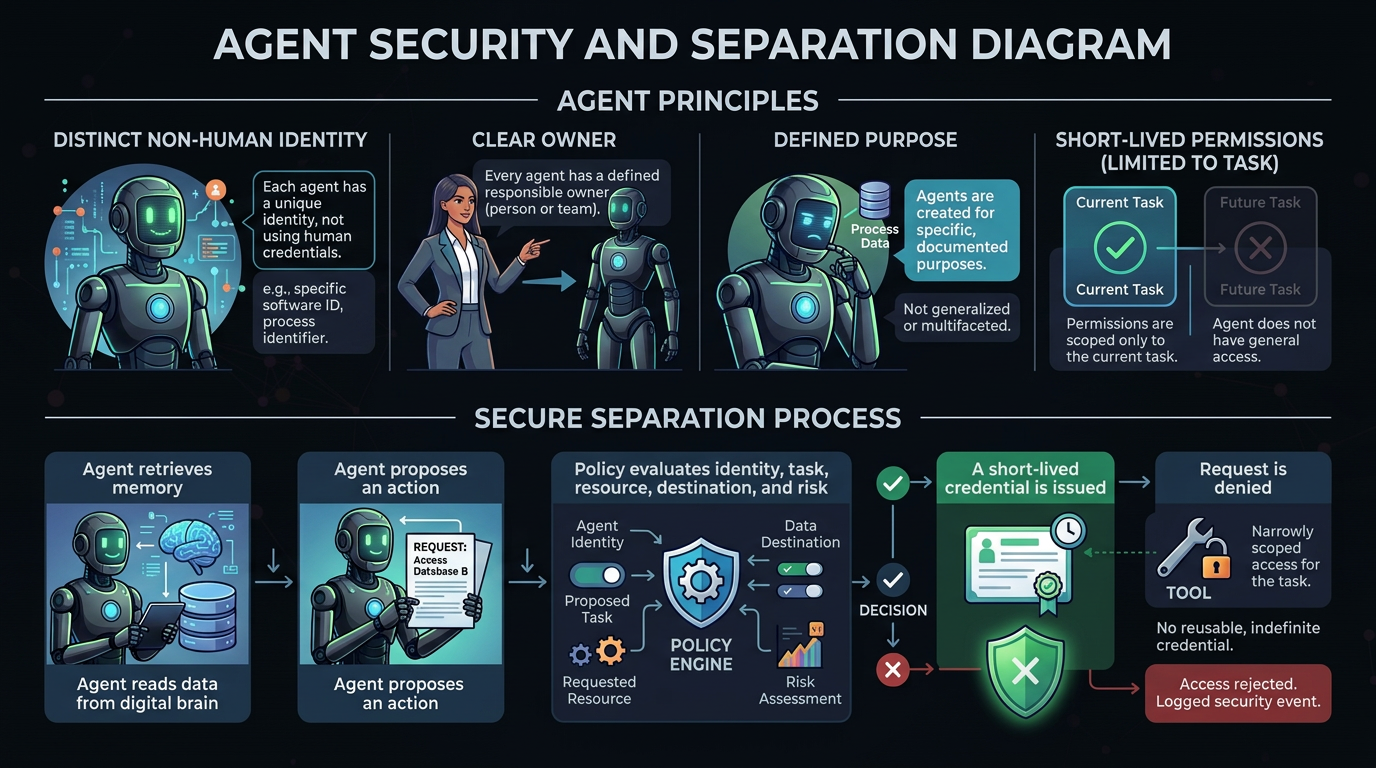
A poisoned or incorrect memory record may influence what the agent asks for. It should not determine what the agent receives.
Keep the Controls Practical
Context analysis can add latency, especially when it depends on another model call. The answer is not to inspect every record with maximum scrutiny.
Use fast checks for every request: tenant scope, identity, schema validation, source metadata, TTLs, and policy checks. Classify content when it is written and store the result with the record.
Reserve deeper analysis for higher-risk cases: external content, shared memory, instruction-like records, stale information, sensitive data, and actions that can modify systems or expose information.
Security should be strongest where context becomes persistent state or privileged action, not where it adds friction without reducing meaningful risk.
Final Thought
Memory gives agents continuity. It also gives mistakes, unsupported assumptions, and untrusted content a chance to persist.
The goal is not to make agents forgetful. It is to make sure they remember the right things, with the right source, scope, lifetime, and level of trust, and that remembered information never becomes authority on its own.
References and Further Reading
-
Microsoft Security — Manage Memory Safety in Agentic Systems https://learn.microsoft.com/en-us/security/zero-trust/sfi/manage-agentic-memory-safety
-
OWASP Cheat Sheet Series — AI Agent Security Cheat Sheet https://cheatsheetseries.owasp.org/cheatsheets/AI_Agent_Security_Cheat_Sheet.html
-
arXiv — A Systematic Study of Memory Poisoning Attacks in LLM Agents https://arxiv.org/html/2606.04329v1
-
OpenReview — Memory Injection Attacks on LLM Agents via Query-Only Interaction https://openreview.net/forum?id=QINnsnppv8
-
Microsoft AI Red Team — Taxonomy of Failure Modes in Agentic AI Systems https://www.microsoft.com/en-us/security/blog/2025/04/24/new-whitepaper-outlines-the-taxonomy-of-failure-modes-in-ai-agents/