
The Haunted Attack Surface
AI is lowering barriers to specialist cyber work and shortening attack timelines. What comes next, and how security teams can prepare before the window closes.
Read postai-securityagentic-aiAudio · ai-podcast
General AI security, defense, and cybersecurity perspectives.
AI is lowering barriers to specialist cyber work and shortening attack timelines. What comes next, and how security teams can prepare before the window closes.
Read post
ThinkingBox makes a simple point about agent evaluation: a valid tool call and a confident final answer do not prove the intended change actually happened.
Read post
A SQL Server Management Studio Copilot flaw shows why database assistants need their own least-privilege credentials instead of relying on read-only instructions in a prompt.
Read post
Persistent memory gives agents continuity, but it also gives untrusted information a chance to outlast the conversation that introduced it.
Read post
Claude Mythos and GPT-5.5-Cyber are not just spotting bugs anymore. They are chaining them into working exploits, and that changes how every security team should think about patch priority.
Read post
AI-generated code often ships clean and then breaks later. This post explains why, and how your language choices and Python safety stack change the maintenance and security bill.
Read post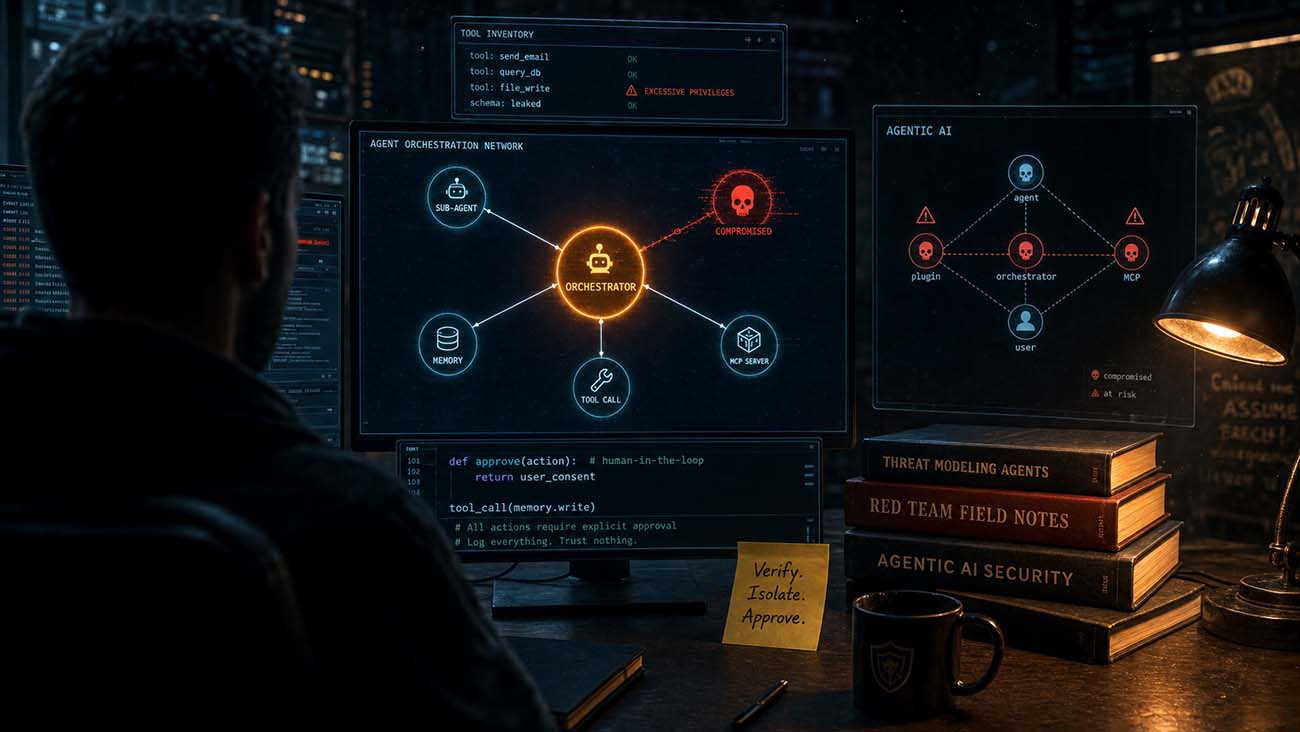
A year of agentic AI red-teaming has exposed seven failure modes that weren't on anyone's radar twelve months ago. Here's how to triage them by where your team actually sits today.
Read post
How non-expert developers trusting AI to pick their dependencies have handed attackers - including nation-states - a structural advantage in the npm and PyPI ecosystems.
Read post
Evaluating the April 2026 releases of Mythos and GPT-5.4 Cyber through the lens of the 'Enterprise Stress Test' where legacy debt becomes an active exploit vector.
Read post
How agentic AI patterns like routers, prompt chains, and orchestrators shape trust, access, prompt injection risk, and blast radius.
Read post
Cybersecurity is turning into an AI-vs-AI arms race. This post explains how attackers and defenders are building AI agent armies—and why the future of defense looks a lot like a living tower-defense game.
Read post
A distilled summary of 2026 AI security consensus from leading vendors—the attack vectors and threats most organizations will face.
Read post
OpenAI just acknowledged that its next-generation models are likely to pose a “high” cybersecurity risk. This post breaks down what that really means: LLMs as dual-use cyber infrastructure, the offense–defense balance, and how to architect your AI stack under an assumed high-risk model.
Read post
A critical look at the Shai-Hulud 2.0 malware campaign and how traditional software supply-chain threats undermine the foundations of AI platforms.
Read post
How AI-powered toolkits are revolutionizing cybercrime — making scalable attacks, deepfake fraud, and adaptive malware in reach of anyone, and what defenders can do to respond.
Read post
An overview of current deepfake detection technologies, industry challenges, and best practices for defending against synthetic media fraud.
Read post
Exploring how the democratization of AI-generated code resembles the flood of AI media 'slop' online—and why insecure, mass-produced code represents an emerging cybersecurity catastrophe.
Read post
OpenAI’s new Atlas browser promises intelligent web navigation but raises serious cybersecurity and privacy concerns. This post explores the potential and pitfalls behind this AI-powered browsing revolution.
Read post
Explore how stochastic computing reduces AI operational costs and how AI security threats are evolving alongside advancements like Model Context Protocol (MCP). A comprehensive look at efficiency and protection.
Read post
Explore the evolving landscape of AI security threats and learn practical strategies to protect your AI systems
Read post